Practical, Uganda-ready workforce diversity solutions that create measurable change inside the office and online.
I share straightforward steps I use with leaders and employees to raise inclusion, reduce friction, and unlock clear benefits for the whole company. Backed by simple policies, leader modeling, and targeted training, these actions improve innovation, productivity, and retention across the organization.
Recent research shows 76% of job seekers consider a varied staff when choosing employers (see Glassdoor research), and reports from development and HR firms note a drop in visible leader support for diversity—so fresh, visible investment is needed. With hybrid and remote work increasing collaboration time, teams need clear communication norms to avoid misunderstandings that cost time and morale.
This guide gives a durable definition of diversity and inclusion you can sustain, a concise business case leaders accept, a step-by-step implementation framework, communication guardrails, training habits, governance metrics, and simple tech (mentoring software and peer learning) to scale guidance across teams and offices in Uganda.
For practical hiring and cross-border recruitment help, see Al Kaabi Jobs. Call or WhatsApp +971589087972 for more information.
Key Takeaways
- Concrete steps connect inclusion to measurable benefits for the company and its customers.
- Leader commitment and clear, accessible policies are nonnegotiable for sustained progress.
- Post‑pandemic hybrid work increases the need for communication norms to reduce friction and lost handoffs.
- Mentoring platforms and peer learning scale practical guidance across teams and diverse locations.
- Templates for listening sessions, simple policy language, and manager routines speed real adoption.
- The recommendations are framed for Uganda so organizations can align multi‑lingual teams and regional hiring efforts.
Why workforce diversity matters now in Uganda’s workplaces
Blended work patterns are reshaping how Ugandan companies operate. As hybrid schedules and longer remote hours become common, clear rules and simple norms are essential to keep employees coordinated, reduce friction, and protect productivity.
Post‑pandemic shifts: hybrid work and new communication challenges
Remote and hybrid models raise the amount of time teams spend collaborating, which can amplify communication gaps when channels are misused. To prevent wasted time and misunderstandings, set channel norms early so people know when to message, call, or meet.
Example channel‑choice card (one line each): Chat = quick updates/links (use short sentences); Call = sensitive clarifications (allow translation time); Meeting = planning/decisions (share agenda); Async note = handoffs (include bilingual summary).
Local relevance: talent, language, and culture in East African organizations
Many skilled people in Uganda learn and work in local languages. Pairing plain language with bilingual support helps those people contribute confidently and reduces errors. Cultural norms also shape how—and when—people ask questions; explicitly normalizing clarifying questions prevents small differences from escalating into conflict.
| ChannelBest forUrgencyLanguage tip | |||
| Chat | Quick updates, links | Low | Keep short, simple terms |
| Call | Clarifications, sensitive topics | High | Allow time for translation |
| Meeting | Planning, decisions | Medium | Share agenda in advance |
| Async note | Detailed handoffs | Low | Use bilingual summary |
Why this matters: Workplace diversity widens access to talent, improves service for local customers, and brings different perspectives that help problem‑solve. Watch early signals—missed handoffs, repeated clarifications, or falling participation—to tune language support and communication norms quickly.
For research on performance in Uganda, see this study.
For a short checklist on channel norms and a sample listening‑session template, request the download or consult the contact at the end of this guide.
Defining a diverse and inclusive workplace I can sustain
I begin by naming what fair treatment looks like in everyday work and by centering manager routines as the engine of lasting change.

Workplace diversity, inclusion, and equity: what I aim to build
I define a workplace where equity ensures fair access to opportunities and resources, and inclusion describes the everyday experience of belonging, voice, and participation. Practically, that means clear role criteria, transparent promotion practices where feasible, and everyday respect for all employees.
- Make civility and zero‑tolerance for discrimination enforceable with plain‑language policies.
- Make equity visible through published promotion criteria and reliable feedback loops (who owns decisions, what success looks like, timelines).
- Embed inclusion into manager 1:1s, stand‑ups, and performance conversations so the company culture shifts through routine management practice.
Cognitive and demographic diversity: understanding differences to reduce conflict
Demographic diversity includes gender, age, religion, language, and backgrounds; cognitive diversity covers education, skills, and thinking styles. Both matter: demographic diversity widens talent pools, while cognitive diversity improves problem solving.
Teach teams to surface assumptions and use structured feedback formats. Small protections — e.g., inviting written input before meetings, giving extra time for non‑native speakers, and using anonymized idea scoring — reduce status gaps and language confidence issues.
Manager routine example: add a 3‑minute agenda item to 1:1s — “barriers I face” — where the manager asks one focused question about access or development and records one action with a deadline.
Call Or WhatsApp +971589087972 For More Information.
The business case I present to leaders
My argument is simple: inclusion must link to clear, measurable returns for the company. I start with hiring impact — Glassdoor research reports that about 76% of job seekers consider a varied staff when choosing employers, which expands the applicant pool and helps companies win scarce talent in Uganda’s markets (cite Glassdoor source when publishing).
Next I show the risks. Reports from HR and development firms (for example, PMI and DDI studies) highlight gaps in leadership representation and a recent decline in visible leader support for diversity. When leadership deprioritizes inclusion, disengagement and exit intent rise — outcomes that reduce productivity and increase hiring costs.
Then I map direct operational benefits. Diverse workforces make better decisions, solve problems faster, and drive innovation — results we translate into shorter delivery cycles, fewer rework hours, and clearer cross‑team collaboration.
- Hiring edge: broader attraction for top job candidates and warmer employer reputation in competitive markets.
- Reputation: stronger trust with customers and partners when the company visibly reflects the communities it serves.
- Operational upside: fewer conflicts, faster delivery, and measurable gains in team throughput.
- Accountability: leadership modeling accelerates adoption and sustains results.
Example, illustrative scenario: reduce voluntary turnover by 5% through targeted manager training and mentoring — estimated savings in hiring and onboarding can offset the first year of training and tools. (Insert company‑specific numbers when building the costed plan.)
I close with a costed plan that links training, tools, and manager time to measurable benefits and retention improvements. Contact me to request a short, costed example tailored to your company or book a planning call via the contact at the end of this guide.
Workforce diversity solutions: my step-by-step implementation framework
This implementation framework links simple actions to measurable results so teams and managers can move forward with confidence.
Begin with a quick assessment: short surveys, targeted listening sessions, and a few baseline metrics. That combination reveals engagement gaps, highlights quick wins, and informs the training and manager coaching needed to change day‑to‑day practice.
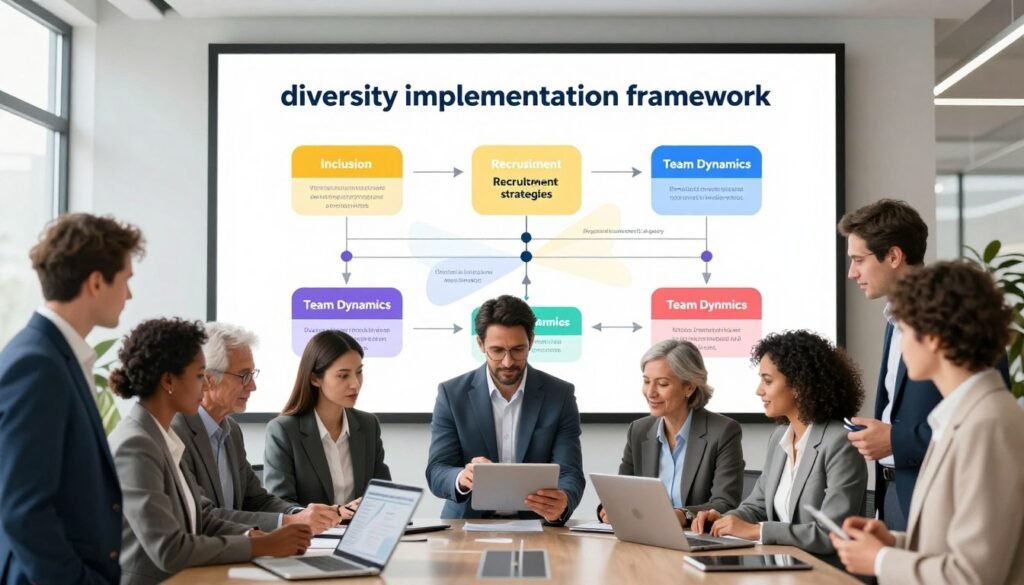
Assess current state: data, listening sessions, and engagement baselines
Collect quantitative metrics (hiring, retention, promotion rates) and short qualitative inputs (3–5 focused listening groups or anonymous prompts). Sample listening prompt: “Describe one process or moment at work where you felt excluded or unsupported — what happened and what would help next time?” Use these answers to set baselines and prioritize quick wins.
Set clear goals aligned to strategy and company culture
Work with leaders to choose a small set of measurable goals tied to business priorities and delivery timelines (example: increase representation in mid‑level roles by X% in 12 months). Give each goal an owner, a target, and monthly check‑in dates so progress is visible and actionable.
Design policies for clarity, accessibility, and zero tolerance
Rewrite key policies in plain language so employees trust reporting routes and understand consequences. Publish short promotion criteria (required skills, sample evidence, timeline) so employees see how decisions are made.
Resource the plan: budget, D&I manager, and leadership ownership
Assign or recruit a D&I lead with clear responsibilities (metrics, owner of listening sessions, training coordination). Secure realistic budget lines for training, mentoring software, and a modest admin budget. Make executive sponsors accountable for outcomes in quarterly reviews.
- Decision rituals: use simple criteria, timeboxed reviews, and quick polls so ideas are evaluated fairly and different perspectives count.
- Mentoring: pick lightweight, mobile‑friendly mentoring software to scale peer learning and cross‑team pairing without heavy admin.
- Reviews: run monthly check‑ins against the dashboard and pivot quickly — keep cycles short to free resources for what works.
Suggested 3‑phase rollout (compact timeline): Pilot (months 0–3) — baseline, listening sessions, 1–2 quick wins; Scale (months 4–9) — roll out manager training, mentoring, and policy updates; Measure & iterate (months 10–12) — review metrics, update goals, document lessons.
Downloadable templates to prepare: listening session guide, sample survey (5 questions), and a goal tracker. Request these assets via the contact at the end of the guide to speed implementation.
Call Or WhatsApp +971589087972 For More Information.
Communication, language, and different perspectives: practical ways I prevent conflict
Clear rules for how we communicate stop small misunderstandings from growing into bigger problems that hurt delivery and morale.
Define simple channel norms so everyone knows when to use chat, calls, async notes, or meetings — this reduces rework and keeps the workplace aligned.
Channel norms: when to use chat, calls, and meetings for clarity
Use chat for quick updates and links, calls (or Zoom) for nuance and sensitive clarification, async notes for handoffs and records, and scheduled meetings for planning and decisions. A one‑line channel‑choice card works well in practice:
Chat = quick update (one line), Call = sensitive/urgent (same day), Meeting = planning/decision (agenda), Async note = detailed handoff (bilingual summary).
Reducing language barriers: simple language, bilingual support, and time to adjust
Keep language plain and encourage clarifying questions so employees feel safe to speak up. Where feasible, provide bilingual summaries for key docs and train bilingual managers to bridge gaps. Give new hires an adaptation period and scheduled check‑ins to lower mistakes while they learn local terms and process norms.
Practical checklist: use plain sentences, avoid idioms, allow 24–48 hours for async responses, and offer translated summaries for key announcements.
Decision rituals: evaluating ideas fairly to harness different perspectives
Use a small trusted review group, timebox debates, and quick polls to land decisions. Require written idea summaries before discussion so different perspectives are compared on merit, not volume.
- Lightweight policies curb exclusionary slang and set a respectful tone for chat.
- Log recurring friction points and iterate norms quickly so communication matches how the team actually works.
- Mobile‑first tip: minimize large attachments, prefer links or compressed files for colleagues on limited bandwidth.
| ToolBest useResponse timeBenefit | |||
| Slack / Chat | Quick updates, links | Within hours | Reduces meeting load |
| Call / Zoom | Nuance, clarifications | Same day | Prevents misinterpretation |
| Meeting | Decisions, planning | Scheduled | Aligns teams |
| Async note | Handoffs, records | 24+ hours | Clear history for employees |
For implementation support and a downloadable channel‑choice card you can adapt for your teams, contact the advisor listed in the conclusion.
Training, leadership, and everyday behaviors that drive inclusion
Programs that turn theory into habit help managers and teams act differently every day—so inclusion becomes routine, not a one‑off effort.
Design training to go beyond slides: short, practice‑focused sessions give managers hands‑on experience in bias awareness and conflict resolution so inclusive behaviors show up in 1:1s and stand‑ups.
I coach leaders to model curiosity and fair recognition. When leaders publicly share concise stories of inclusive wins, employees see the behavior rewarded and repeat it—this strengthens company culture and builds trust across teams.
Diversity training that sticks: bias awareness and conflict resolution
Short, scenario‑based exercises let every participant practice de‑escalation, delivering growth feedback, and interrupting bias. Role plays are low‑risk and high‑impact; follow them with on‑the‑job micro‑assignments to reinforce learning.
Sample 30‑minute module outline:
- 5 min — quick intro + objective (what success looks like).
- 10 min — scenario role play in small groups.
- 10 min — structured reflection and action commit (one change to try this week).
- 5 min — measurement note (what to track: manager use of inclusive language, 1:1 agenda item completed).
Measurable KPIs after training: % managers completing scenario practice, % of 1:1s with inclusion agenda item, change in sentiment for underrepresented groups, and participation rates in mentoring.
Inclusive leadership: modeling behaviors and sharing success stories
Ask leaders to highlight a short “Inclusive Win” each month: 2–3 sentences that name the behavior, its impact, and the person or team involved. Example prompt leaders can use: “This month, I noticed X do Y to include Z; it helped us achieve [outcome].”
Small public rituals — shoutouts in stand‑ups, inclusion items in all‑hands, and visible recognition of cross‑team mentorship — change norms faster than memos.
Mentoring and peer learning: using software to scale guidance
Use lightweight, mobile‑friendly mentoring platforms to pair people across backgrounds. That breaks silos, builds trust, and spreads practical skills without heavy admin work. Track matches, meeting frequency, and qualitative feedback to measure impact.
- Practice over theory: prioritize scenario work and micro‑assignments that change behavior on the job.
- Leader modeling: public recognition and short inclusive storytelling keep momentum.
- Scaled guidance: mentoring platforms to pair, track progress, and share resources.
- Measure impact: participation, sentiment change, and behavior metrics tied to retention and productivity.
Request a demo of a 30‑minute module, or download a manager 1:1 agenda template to start practicing this week. Contact details are in the conclusion. For practical reading on applied approaches, see diversity and inclusion resources.
Governance, metrics, and continuous improvement I rely on
I build a small, practical dashboard managers in Uganda can actually use to track progress and course‑correct quickly.
Set a lightweight governance rhythm so leaders and teams review clear numbers monthly. Short review cycles keep the organization focused, prevent programs from turning into busywork, and surface where to reallocate effort.
Metrics that matter: retention, promotion, participation, and sentiment
Track a compact set of KPIs that highlight access and outcomes. Suggested dashboard (3–4 KPIs):
- Retention rate — rolling 12‑month voluntary turnover (%), flagged by role level.
- Promotion velocity — time to promotion for internal hires (median months) and promotion rate by group.
- Participation — % of employees attending training, mentoring matches, or ERG events (by cohort).
- Sentiment — pulse score for inclusion/psychological safety (monthly or quarterly).
One‑line definitions: retention = (1 − voluntary exits/average headcount) ×100; promotion velocity = median months to next level for promoted employees; sentiment = weighted score from 3‑question pulse on belonging, voice, and fair treatment.
Feedback loops: surveys, ERGs, and regular goal reviews
Combine anonymous pulse surveys with ERG or focus‑group listening sessions to get both qual and quant signals. Run monthly or quarterly goal reviews where owners report progress and propose adjustments — short, focused meetings keep momentum.
- Monthly dashboard: simple charts leaders review with teams (top 3 metrics and one insight/action).
- Audit policies: periodic checks to ensure consistent application and build trust.
- Transparent metrics: share high‑level results with employees to build credibility without exposing individual data.
- Qual + quant: triangulate survey scores with ERG feedback and manager check‑ins to prioritize actions.
- Document lessons: capture decisions, who owns follow‑ups, and measurable outcomes for the next cycle.
Governance cadence example (RACI in one line): Leader = Accountable (reviews dashboard monthly), D&I lead = Responsible (prepares data and actions), HR/business manager = Consulted (operational changes), Managers = Informed (team-level actions). To protect privacy, anonymize small‑group cells and combine metrics where sample sizes are small.
Contact the advisor in the conclusion to request a sample dashboard template, metric definitions spreadsheet, and a short governance checklist you can adapt for your company.
Tech-enabled inclusion: tools I use to elevate every voice
Smart, mobile‑friendly tools capture signals early so small issues don’t become big problems. I choose technology that fits the realities of companies in Uganda: simple, fast, mobile‑first, and tolerant of limited networks.
AI and predictive insights to spot risks early
Predictive signals and fast intervention
Use AI dashboards and simple analytics to surface leading indicators—falling participation, lower sentiment, or shrinking cross‑team collaboration—so managers can coach before problems harden. If a team’s mentoring attendance drops by 20% month‑over‑month, an alert can trigger a targeted check‑in rather than waiting for formal complaints.

Clear language and recorded contributions
Run policy‑language checks and standardize idea capture so quieter employees and different perspectives are recorded. Logged contributions and short summaries let everyone’s viewpoint count and create an auditable record for decisions.
- Vendor/feature checklist: mobile/offline support, light bandwidth mode, multilingual plugins, simple analytics, and secure export for reporting.
- Example alert scenario: predictive dashboard flags a drop in pulse scores for a team → manager receives an action item to run a 15‑minute listening huddle and log outcomes.
- Keep tools lightweight and mobile‑first to ensure broad uptake across the organization.
Privacy & data governance: aggregate and anonymize small cohorts, restrict raw data access to D&I leads, and document retention policies so predictive analytics inform coaching without exposing individuals.
Outcomes I track: fewer conflicts, faster decisions, clearer accountability, and improved participation across teams. Tune configurations from feedback so tech strengthens diversity and inclusion without adding noise.
Contact the advisor listed in the conclusion to request a vendor checklist and an example alert workbook you can adapt for your company.
Conclusion
I wrap up with a practical checklist to turn inclusion ideas into daily habits that teams actually use.
Practical change needs leader modeling, clear policies, and steady reviews. When leaders apply training and employees see fair process, the company builds trust and improves productivity.
Keep momentum with simple rituals, helpful tools (AI‑enabled dashboards for early warnings), and regular check‑ins that make improvement feel easier, not heavier. Honor culture and backgrounds, manage issues quickly, and let teams share results.
Three actions to take this week:
- Improve one communication process (e.g., publish a channel‑choice card).
- Clarify one policy (publish a one‑page promotion or reporting checklist).
- Book one training slot (15–30 minute practice module for managers).
Request a 30‑minute plan review and a sample checklist tailored to your organization — contact via Call or WhatsApp +971589087972 or use the contact link in this guide to schedule a short consultation.