I’m excited to share a clear, data-backed snapshot of the current work landscape. In 2025, global employment sits at 61.2%. Remote adoption reaches 45%, while 36% of workers join the gig economy. AI-augmented roles have risen 52% since 2023.
I track the signals that matter: employment rates, remote uptake, gig participation, and AI growth. These numbers show how companies and organizations redesign work with hybrid models and distributed teams.
From Uganda, you can tap new opportunities as businesses lean on regional skill hubs. Cross-border hiring expands, and many roles now reward skills over degrees. If you want tailored guidance, Call or WhatsApp +971589087972.
Key Takeaways
- Employment is steady at 61.2%, with clear room for growth.
- Remote and hybrid models open more roles without relocation.
- AI-augmented roles are growing fast—skill shifts matter.
- Gig participation and regional hubs expand access from Uganda.
- Use data-driven moves to prioritize high-upside opportunities.
- Contact me on WhatsApp for tailored, practical next steps.
2025 at a glance: a fast-evolving world of work shaped by AI, hybrid models, and green growth
I focus on three headline signals that define 2025: a 61.2% global employment rate, 45% remote adoption, and 36% gig participation. These data points combine to reshape daily work and role design.
AI is a multiplier: AI-augmented roles rose 52% since 2023, shifting routine tasks to automation and lifting the value of high-skill work. That changes how companies hire and how workers package skills.
Formal hybrid models are stabilizing. Employers now document processes and hire across borders more confidently. This creates steady remote roles and clearer expectations for productivity and collaboration.
For Uganda, youth demographics meet digital acceleration. Young workers can convert connectivity into paid roles as employers formalize remote-ready operations across Kampala, Gulu, and Mbarara.
Key signals
- Employment rate: 61.2% — a baseline for recovery and policy action.
- Remote adoption: 45% — hybrid models reduce geographic friction.
- Gig participation: 36% — platform-based work scales alongside formal roles.
| Indicator | 2023 | 2025 | Implication |
|---|---|---|---|
| Employment rate | 59.0% | 61.2% | Slow improvement; skills focus required |
| Remote adoption | 30% | 45% | More roles work-from-anywhere |
| Gig participation | 28% | 36% | Flexible income paths expand |
| AI-augmented roles | Baseline | +52% | Task redesign and upskilling needed |
Use research-backed indicators — including analysis from sources like the World Economic Forum — to benchmark choices. For a practical guide on the future of work and next steps, Call Or WhatsApp +971589087972 For More Information.
What international job market trends really capture in the present
Right now I see clear patterns in hiring, skills demand, and how companies redesign roles.
Trends are not guesses. They are observable shifts in postings, salary bands, and certification signals that show what employers value.

From creation to displacement: how AI and automation rebalance roles
AI, robotics, cybersecurity, and cloud platforms are part of daily operations. That creates roles like AI operations and workflow automation.
Routine tasks are automated. That means roles are redesigned and workers need reskilling rather than facing mass layoffs.
Tracking skills, work arrangements, and policy shifts
Organizations update systems for performance, collaboration, and governance as models move hybrid or remote.
- I track real-time data from job postings and pay bands to reveal employer priorities.
- Policy shifts on remote work and AI governance affect access and hiring rules.
- Candidates should read these patterns and combine intelligence across sources to reduce risk.
| Signal | What it shows | Action |
|---|---|---|
| AI roles | New task bundles | Reskill for automation ops |
| Hiring data | Skills demand now | Match certifications |
| Work models | Hybrid and remote norms | Document collaboration skills |
Call Or WhatsApp +971589087972 For More Information.
Macro drivers transforming employment: AI, globalization, demographics, and sustainability
Several big drivers — tech, demographics, policy, and sustainability — are reshaping how we earn and organize work.
Artificial intelligence and human-in-the-loop productivity gains
I see structured AI-human frameworks lift output dramatically. Research shows up to 75% productivity gains and 60% better decision accuracy when people and systems collaborate.
This means automation augments roles rather than erases them, so I advise designing tasks around human judgment plus machine speed.
Globalization and cross-border hiring
Companies decentralize teams to tap specialized skills across time zones. That makes distributed work a practical default for many firms.
I encourage Ugandan employers and candidates to build reliable remote processes and clear collaboration protocols.
Demographic divergence
Aging economies lean on automation and migration to fill gaps. Youthful regions face skill mismatches that require fast reskilling and job creation.
Green transition and workforce shifts
Sustainability mandates drive real hiring in clean energy and ESG roles. The U.S. now counts millions in clean energy jobs, and renewables keep expanding.
For employers and job seekers, the interaction of technology diffusion, demographic pressure, and policy incentives points to growth in AI ops, green construction tech, and climate data services.
Call Or WhatsApp +971589087972 For More Information.
Regional dynamics to watch: where growth, skills, and policies diverge
Each part of the world is writing a different playbook for skills, hiring, and firm strategy. I map how policy and industry focus shape real opportunities for talent in Uganda.
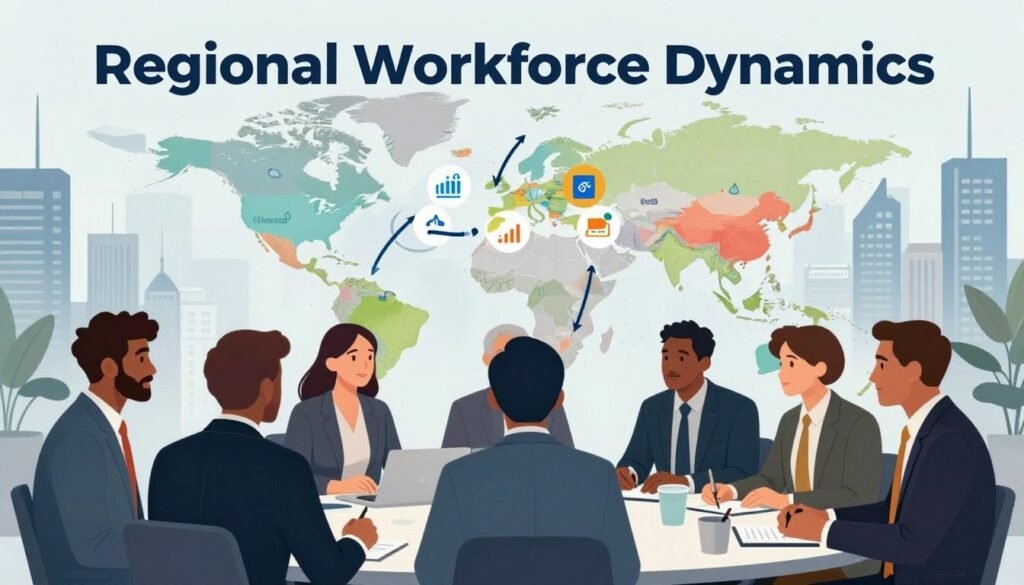
Africa’s youthful workforce and digital leapfrogging
Africa leverages mobile-first access and youth demographics to scale services and tech roles. I see strong employment programs and agri-modernization driving practical skill gains.
North America’s tech engine and remote-first maturity
North America leads in tech expansion and remote adoption. Companies there set standards for distributed teams and hiring models that others copy.
Europe’s sustainability bets and flexible labor reforms
Europe focuses on green energy and flexible labor rules. That creates new sectoral demand in clean energy and regulated hiring paths.
Asia-Pacific’s automation scale and skills pipelines
Asia-Pacific scales manufacturing automation and continuous skilling programs that feed global supply chains.
Latin America’s entrepreneurship and time-zone advantages
Latin America grows design, QA, and full-stack services with strong U.S. alignment and nearshore appeal.
“Regional policy, industry focus, and workforce maturity determine where skills translate into steady employment.”
- I use data to help Ugandan candidates pick sectors and learning pathways.
- I recommend targeting regions where your skills fit the demand curve.
- Call Or WhatsApp +971589087972 For More Information.
| Region | Strength | Implication for talent |
|---|---|---|
| Africa | Youth + mobile adoption | Leapfrog roles in services and mobile dev |
| North America | Tech & remote norms | High remote openings, skill premium |
| Europe | Green jobs & reforms | Sectors shift toward sustainability roles |
| Asia-Pacific | Automation & upskilling | Scale hiring in manufacturing and cloud ops |
| Latin America | Entrepreneurship + time zones | Nearshore product and engineering work |
Cross-border talent pipelines in practice: mapping skill hubs and fit
Finding the right regional hub means balancing skills depth, language, and time-zone fit. I compare practical signals so you can pick a fit that reduces risk and speeds hiring.
India & Southeast Asia
Large pools in software, data engineering, and AI operations make these hubs cost-efficient. Strong English skills and scale suit companies that need systems and automation at pace.
Latin America
Design, QA, and full-stack work align well with U.S. time zones. This region helps organizations deliver rapid product cycles with tight collaboration windows.
Eastern Europe
Deep cybersecurity and backend engineering talent offer resilience for critical systems. Firms often pick Eastern Europe for complex technical builds and security expertise.
Africa
Selected African markets now scale cloud support, mobile development, and data operations. A young workforce and fast digital adoption make these hubs strong entry points for global teams.
- Work models: contractors, EOR, and hybrid hubs each serve different growth stages.
- Operational basics: document processes, use async workflows, and build onboarding systems.
- Compliance: handle classification, payroll, and local laws to reduce risk.
- Infrastructure signals: payments, connectivity, and coworking density guide readiness checks.
| Region | Strength | When to use |
|---|---|---|
| India & SE Asia | Scale in software & AI ops | When you need cost-efficient engineering at volume |
| Latin America | Design, QA, full-stack | When time-zone alignment with the U.S. matters |
| Eastern Europe | Cybersecurity & backend depth | When systems and security are priority |
| Africa | Cloud support, mobile, data ops | When you want emerging hubs and youthful workforce |
I recommend piloting small teams, measuring engagement, and then scaling the model that shows the best retention and output.
Call Or WhatsApp +971589087972 For More Information.
The skills economy: capability-based hiring, pay, and learning acceleration
I see hiring move fast from degree checks to clear, verifiable outcomes candidates can show in days.
Capability-based systems change how pay and promotion work. About 72% of Fortune 500 now use skill matrices to set pay scales. That shifts value toward demonstrated competencies and project evidence.

Skill-based compensation and matrices replacing degree-first models
Organizations and companies use rubrics and role architectures to measure contribution. This reduces bias and rewards adaptability over tenure.
Hot skill stacks
The most defensible combinations pair technical depth—AI/ML, data architecture, cybersecurity—with digital leadership and cross-cultural communication.
Continuous learning ecosystems
Micro-credentials, certifications, and internal programs speed promotion and internal mobility. I advise building a portfolio of projects, repos, and verified outcomes that employers can read quickly.
- I explain: capability hiring replaces degree-first screening and raises visible competencies.
- I detail: compensation models now index to skills depth, not just titles.
- I map: fast paths for Ugandan talent to earn recognised credentials and signal job readiness.
| Metric | Signal | Action |
|---|---|---|
| Skill matrices | 72% adoption | Build clear evidence |
| AI-human systems | Productivity +75% | Learn tools to leverage intelligence |
| Hot stacks | AI/ML + Cyber + Data | Pair with leadership |
Call Or WhatsApp +971589087972 For More Information.
Work models that stick: hybrid, gig platforms, and flexible weeks
Practical changes in scheduling and contracts are creating work patterns that stick for teams and independent workers.
Hybrid arrangements reduce resignations by about one-third and report the highest engagement among modes. I find the core reason is simple: teams that document expectations and processes keep people informed and steady.
Hybrid work’s engagement edge and documentation culture
I advise organizations to set clear communication windows and doc standards. When companies document decisions, engagement rises and productivity follows.
The gig surge: platformized projects and portfolio careers
Gig platforms let workers assemble portfolio careers with flexible income and global exposure. Freelancers remain optimistic, and gig participation supports broader employment options.
- I map how companies balance synchronous meetings with asynchronous deep work to lift productivity.
- Flexible weeks—four-day pilots showed higher satisfaction without lower output.
- I recommend programs to onboard, mentor, and evaluate distributed teams fairly.
- Ugandan professionals should package clear deliverables and short portfolios for remote gigs and hybrid roles.
| Model | Why it works | Action |
|---|---|---|
| Hybrid | Better engagement | Document norms; set overlap hours |
| Gig | Flexible income | Build short, verifiable portfolios |
| Flexible weeks | Higher satisfaction | Pilot and measure output |
Call Or WhatsApp +971589087972 For More Information.
Compensation, transparency, and employer value propositions in 2025
Salary disclosure laws in 2025 require good-faith ranges in postings. I watch how this shifts hiring from vague promises to clear, comparable offers.
Pay transparency and market-linked ranges reshape attraction
New rules push companies to update compensation systems and share benefits openly. That helps workers compare offers fast and reduces negotiation friction.
I explain: published ranges change attraction by setting realistic expectations and shortening hiring cycles.
- I show how companies rebuild pay bands to align with skills, performance, and market benchmarks.
- I outline employer value proposition pillars candidates now check: fair ranges, flexibility, growth, and purpose.
- I demonstrate how clear data in postings accelerates learning for both workers and hiring teams.
“Transparency builds trust — and it speeds the hiring process for honest employers.”
Practical steps: position skills with evidence, publish progression bands, and tell authentic stories about pay and DEI. Employers that do this attract better matches and cut cycle time.
Call Or WhatsApp +971589087972 For More Information.
People-first evolution: DEI, wellness ROI, and a five-generation workforce
A people-first approach links inclusion, mental health, and measurable business outcomes. I frame DEI and well-being as strategic levers that boost performance and lower risk.
Measuring inclusion beyond compliance
Measuring inclusion beyond compliance for performance impact
I show how diverse leadership drives better returns and clearer employment outcomes. Organizations that treat DEI as a performance strategy see stronger retention and faster growth.
Well-being as strategy: burnout reduction, retention, and satisfaction gains
Comprehensive wellness programs can yield about 300% ROI. They cut burnout by 45%, lift retention 60%, and raise job satisfaction by 85%.
I recommend embedding health into work design and linking programs to measurable engagement metrics.
Gen Z to Boomers: reverse mentoring and career path clarity
Five generations at work need rituals that build psychological safety. Reverse mentoring pairs digital fluency with institutional wisdom and strengthens learning and skills transfer.
- I map simple rituals, forums, and manager training to measure experience, not just output.
- I align learning plans with role development to support internal mobility.
| Metric | Why it matters | Target | Action |
|---|---|---|---|
| Engagement score | Signals inclusion | +15% | Monthly pulse and manager coaching |
| Burnout index | Predicts turnover | -45% | Wellness programs & workload checks |
| Retention rate | Reflects value | +60% | Career paths & learning budgets |
| Satisfaction | Signals fit | +85% | Regular feedback and role clarity |
Call Or WhatsApp +971589087972 For More Information.
What I recommend now: strategies for employers and job seekers in Uganda
Now is the time to turn signals into concrete actions for workforce growth in Uganda.
For employers I advise operationalizing remote work with documented processes, secure access, and clear communication norms.
- AI enablement programs: invest in tools, training, and change management to lift productivity through AI-human collaboration.
- Define skill paths: build role architectures and skill matrices that map advancement, pay bands, and learning plans.
- Infrastructure checklist: devices, connectivity, and security to support distributed teams.
For job seekers
I recommend you stack technical depth (data, cloud, cybersecurity) with human skills like communication and problem solving.
Build a portfolio, earn targeted certifications, and use platform projects to reach global remote roles.
“Skill matrices and hybrid policies make career paths clearer — show the evidence and you speed hiring.”
| Audience | Priority | Quick action |
|---|---|---|
| Employers | Remote ops, AI enablement | Document processes; run pilot programs |
| Job seekers | Skills + portfolio | Certify, publish projects, apply to platform roles |
| Both | Infrastructure & learning | Checklist devices, connectivity, training programs |
Call Or WhatsApp +971589087972 For More Information.
Conclusion
What matters most is how organizations and workers turn tools into repeatable value, not just adoption for show. The 2025 landscape is more digitized and distributed, with AI embedded, skill-based pay common, and sustainability shaping hiring across sectors. These converging signals change employment and career paths.
Act now: learn tools that augment your work, build visible skills, and prioritize wellbeing. Companies that document remote operations and foster trust win talent and performance. Automation should increase your value, not replace judgment.
For personalised guidance, Call Or WhatsApp +971589087972 For More Information.